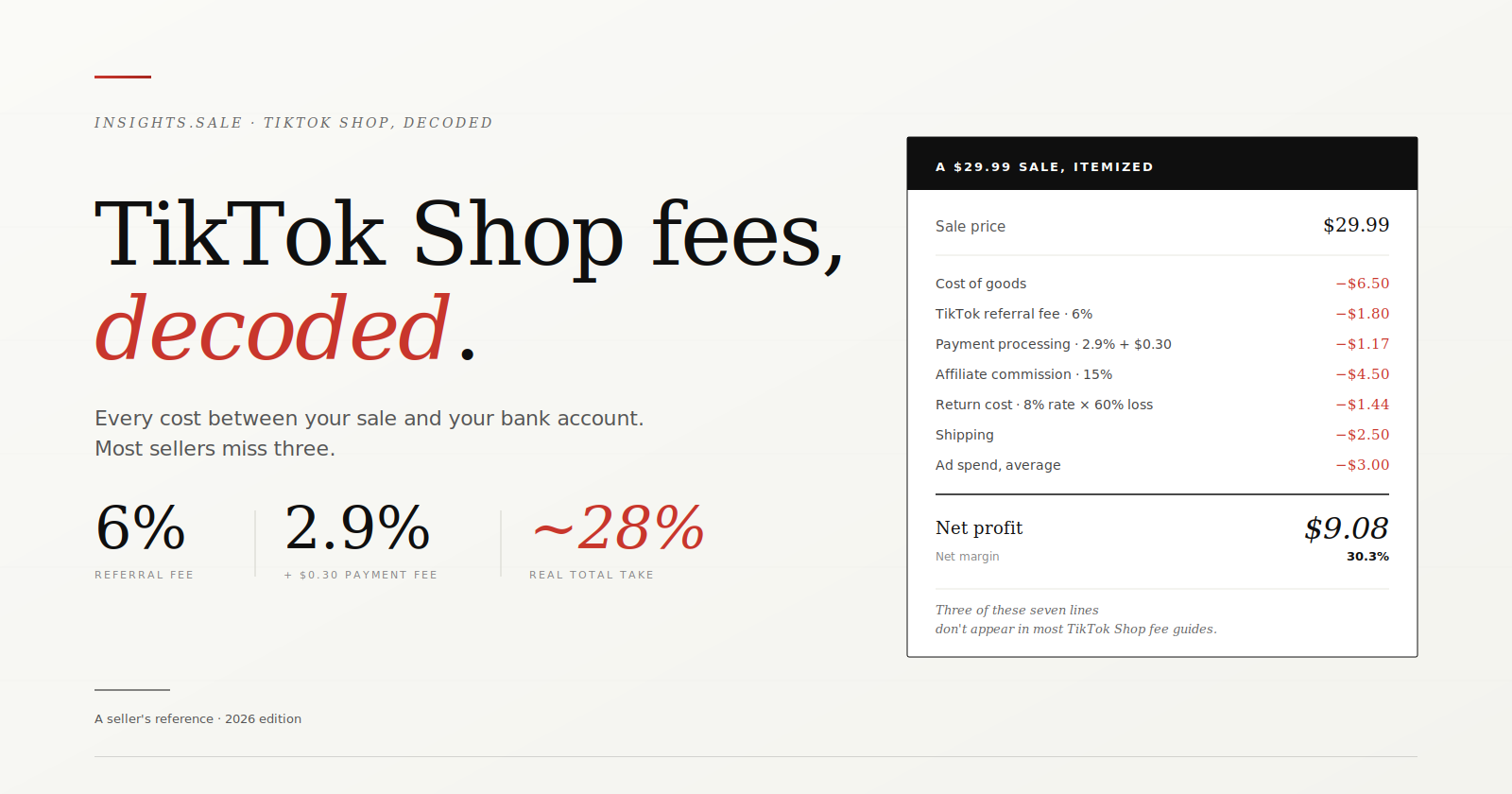
Most TikTok Shop sellers think they're earning a 50% margin. They're earning 28%.
The difference is everything most fee guides leave out: the affiliate commission you set yourself, the return rate quietly eating your COGS, the ad spend baked into every "organic" sale, and the payment processor cut nobody mentions. This guide breaks down every cost — visible and hidden — that comes between your selling price and what actually lands in your bank account.
By the end, you'll know exactly what to charge to hit a real 30% margin, and which fee lines you can negotiate, optimize, or avoid.
The 7 Costs That Touch Every TikTok Shop Sale
Every sale on TikTok Shop passes through up to seven cost lines before profit lands in your account. Here's the order they're applied:
| # | Cost | Rate | Who Sets It |
|---|---|---|---|
| 1 | Cost of Goods Sold (COGS) | Varies | You |
| 2 | Referral Fee (Commission) | 5–8% | TikTok |
| 3 | Payment Processing | 2.9% + $0.30 | TikTok / processor |
| 4 | Affiliate Commission | 5–30% | You (per product) |
| 5 | Return Cost | 5–20% of sales | The market |
| 6 | Shipping | $2–$8 | You / buyer |
| 7 | Ad Spend | Variable | You |
The first three are unavoidable. The next four are where most sellers lose money without realizing it. Let's go through each.
1. TikTok Shop Referral Fee — The Visible One
The referral fee is what TikTok calls its commission. For most categories in 2026, it's 6% of the sale price.
A few categories have different rates:
| Category | Referral Fee |
|---|---|
| Beauty & Personal Care | 6% |
| Women's & Men's Apparel | 6% |
| Health & Wellness | 6% |
| Home Goods | 6% |
| Fitness & Sports | 6% |
| Pet Supplies | 6% |
| Jewelry & Accessories | 5% |
| Electronics & Tech | 8% |
| Other | 6% |
On a $29.99 sale at 6%, that's $1.80 going to TikTok. Predictable. Easy.
This is what most sellers see and plan around. It's also where the real story ends for most fee guides — which is why those guides are misleading.
2. Payment Processing — The Forgotten One
TikTok Shop also takes a payment processing fee on top of the referral fee. The rate is 2.9% + $0.30 per transaction — essentially what Stripe and Square charge.
On the same $29.99 sale, that's another $1.17.
Most sellers either confuse this with the referral fee or assume it's included. It's not. Combined with the referral fee, TikTok itself is taking ~10% of every sale before you've factored in anything else.
3. Affiliate Commission — The One You Set Yourself
If you're using TikTok's Affiliate Program (and you almost certainly should be — affiliate-driven sales are roughly 35% of TikTok Shop GMV in 2026), every affiliate sale also includes a commission you pay to the creator.
Typical ranges by category:
| Category | Common Affiliate Commission |
|---|---|
| Beauty | 15–25% |
| Apparel & Fashion | 10–20% |
| Wellness & Supplements | 20–30% |
| Home Goods | 10–15% |
| Electronics | 5–10% |
This is the single biggest fee on most sales — and the one sellers most often forget to model. On a $29.99 sale with a 15% affiliate commission, that's $4.50 — more than double the referral fee.
The leverage: this is the one fee you control. Set it too high and your margin disappears. Set it too low and no creator promotes you. The sweet spot is usually 15–20% for new products (to attract initial creator interest) and 8–12% once you have momentum.
4. Returns — The Hidden Margin Killer
Returns are where most sellers get blindsided. The published refund cost looks like just the refund itself, but the real cost is much bigger.
When a unit is returned:
- You refund the full sale price
- You typically eat return shipping
- The product often arrives unsellable (especially in beauty and apparel)
- Restocking labor isn't free
A reasonable estimate: a returned unit costs you roughly 60% of the sale price, even though you've already paid out the affiliate commission and absorbed the referral fee on the original sale.
Average return rates by category on TikTok Shop:
| Category | Typical Return Rate |
|---|---|
| Beauty | 5–8% |
| Apparel & Fashion | 15–25% |
| Wellness/Supplements | 4–7% |
| Home Goods | 8–12% |
| Electronics | 10–15% |
| Pet Supplies | 5–8% |
On a $29.99 product with an 8% return rate at 60% loss factor, the return cost per sale is: $29.99 × 8% × 60% = $1.44 — for every sale you make, regardless of whether that specific one is returned.
Sellers in apparel commonly miss this entirely. A 22% return rate × 60% loss factor means 13% of every sale is gone before you even see it.
5. Shipping — Depends on Your Model
Three scenarios:
| Model | Who Pays | Impact on Your Margin |
|---|---|---|
| Free shipping (you absorb) | You | Direct cost: $2–8 per unit |
| Paid shipping (buyer pays) | Buyer | No direct cost, but lower conversion |
| Fulfilled by TikTok (FBT) | Shared | TikTok handles, you pay storage + per-unit fees |
Most sellers absorb shipping to compete on price. Average US TikTok Shop shipping is $3–5 per unit for sub-$50 products.
If you're shipping from China or using a third-party logistics provider, you'll typically pay $4–7 per order. Sellers using TikTok's Fulfilled by TikTok (FBT) program pay a per-unit fulfillment fee that varies by product weight and size.
6. Ad Spend — The Cost of Being Discoverable
Even "organic" success on TikTok Shop usually requires paid amplification. Most sellers run some combination of:
- Spark Ads boosting organic content ($0.50–$2 CPM)
- In-feed Shop Ads driving cold traffic ($5–15 CPM)
- Live shopping promotion during live sales
Average ad spend per unit for actively scaling sellers: $2–5 per sale in the first year, often higher in saturated categories like beauty.
This isn't optional anymore. The "organic only" TikTok Shop window largely closed in 2024–2025 as the category got crowded. Plan for ad spend as a permanent cost line.
The Real Math: A $29.99 Beauty Product
Here's how the seven costs play out on a typical $29.99 beauty product sold on TikTok Shop with a 15% affiliate commission and 8% return rate:
| Line Item | Amount | % of Sale Price |
|---|---|---|
| Sale Price | $29.99 | 100% |
| − COGS | −$6.50 | 21.7% |
| − Referral Fee (6%) | −$1.80 | 6.0% |
| − Payment Processing (2.9% + $0.30) | −$1.17 | 3.9% |
| − Affiliate Commission (15%) | −$4.50 | 15.0% |
| − Returns Cost (8% × 60% loss) | −$1.44 | 4.8% |
| − Shipping | −$2.50 | 8.3% |
| − Ad Spend (avg) | −$3.00 | 10.0% |
| Net Profit | $9.08 | 30.3% |
Net margin: 30.3%. Not 50%. Not 40%. 30%.
And that's a healthy, well-run brand. Most sellers running this same math honestly land closer to 18–22% net margin because they undercharge or over-commission affiliates.
Where Sellers Most Commonly Get It Wrong
Three patterns we see across thousands of TikTok Shop stores:
1. They model on Sale Price minus COGS minus Referral Fee. That gives a fake 60–70% margin. They price aggressively based on that number. Then six months later they're confused why they're not profitable.
2. They underestimate returns. Especially in apparel and beauty. A brand running 22% returns and assuming 8% is leaving 14 points of margin on the table — invisibly.
3. They forget payment processing. The 2.9% + $0.30 is small per unit but compounds. On 10,000 monthly orders, it's roughly $14,700/month in fees most sellers didn't budget for.
The Levers You Actually Control
Of the seven cost lines, you have meaningful control over four:
| Lever | Action |
|---|---|
| COGS | Negotiate better with suppliers at 1K, 5K, and 10K unit tiers |
| Affiliate Commission | Start at 15–20%, drop to 8–12% once you have momentum |
| Return Rate | Better sizing guides, clearer product descriptions, better packaging — most apparel brands can cut returns by 30% with sizing fixes alone |
| Ad Spend | Tighter audience targeting and stronger creative — most brands waste 40% of ad spend on weak audiences |
You can't change the referral fee, payment processing, or shipping rates in any meaningful way. So don't waste energy there. Focus on the four levers above.
Calculate Your Own Real Margins
We built a free TikTok Shop Fee Calculator that runs all seven cost lines for you. Plug in your selling price, COGS, category, and current return rate — you'll see your true net margin in seconds.
→ Try the free TikTok Shop Fee Calculator
If your calculated margin is under 20%, you're either undercharging, paying affiliates too much, or sleeping on a hidden cost. The calculator will show you which.
Quick Recap
- TikTok Shop's visible fee is 6% (5–8% by category) — but the real "platform take" is closer to 10% once you include payment processing.
- The biggest cost most sellers miss is affiliate commission — often 15% of sale price.
- The most invisible cost is returns — 8% return rate × 60% loss factor = 4.8% of every sale, even unreturned ones.
- A healthy TikTok Shop net margin is 25–35%, not 50%.
- You control 4 of 7 cost lines — focus your optimization there.
Last updated: June 2026. Fee structures may change; always verify current rates in your TikTok Shop Seller Center.